
Author / Handulle
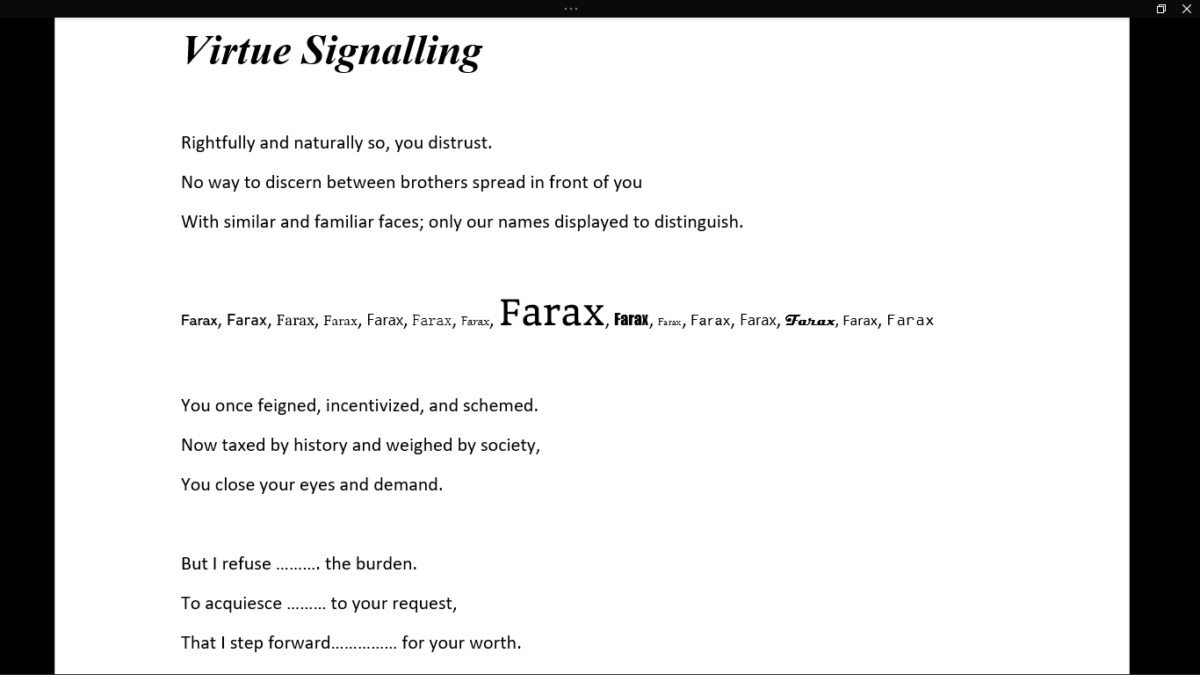
Virtue Signalling
Bismillaah, tawakkaltu ‛alal-laah, wa laa ḥawla wa laa quwwata illaa billaah
I ran back up the stairs I had just descended.
Barely a few steps away from the hotel is when it hit me. My stomach churning. Still unaccustomed to the natural food.
As I ran up the stairs, two steps at a time I saw Abdi – a blur as I rushed passed him.
He didn’t see me.
I rejoiced at my temporary moment of ninja like speed.
***
Abdi had chided me earlier as I was taking my lunch up to my room. I could barely hold a conversation with the intoxicating smell of spiced lamb coming from my white plastic bag in hand and wafting through the air.
We ran into each other near the lobby, his face still wet from wuddu. The front of his hair glistening from recently being washed and small water droplets visible on top of his short cut black hair. As I shook his wet hand, my suspicions of his purification was confirmed.
“Asc walaal” he said.
“Wcs” I replied.
“Maxaa salaat Jimca uu tukan waysi?” he asked with the concerned look of an older brother. My intention to not pray apparent.
“Inshallah” I quickly said before continuing my walk up the stairs. With each step of getting closer to the door, my mouth watering a little more in anticipation.
He muttered what was probably a prayer to help me see the better path.
***
I ran up three more flights of stairs, no longer seeking the path of a stealthy ninja – my stomach continuing its threat. When I reached the door to my room, rushed and shaky hands dropped the keys. I groaned not appreciating the effort it’ll take to pick them up. Once the herculean task was done and my keys were back in hand, I quickly entered my room.
After fifteen minutes of being in the washroom, I heard the hotel room door open – a muffled creek emanating briefly.
Did I lock the door behind me? I wondered.
My heart raced as I slightly panicked with the image of who might be coming entered my mind. Encountering the cute cleaning girl like this would definitely not help my plans to ask her for shah and sweets later this week.
The door made a silent click as it was closed. I heard the footsteps approaching the bathroom door. My throat becoming dry as I prepare myself to yell I was in here and accept my fate.
But the sounds of shuffling feet passed by and stopped near where the dresser was.
“Mahubtaa inuusan soo noqonaynin?” came a males voice that sounded familiar.
“Ha, mardow baan arkay isaago baxay.” Came Abdi’s voice.
I remained silent, frozen as I wondered why they were in here. Maybe Abdi and the other guy are doing some quick repairs, I thought.
I voiced my desire for a functioning fan to combat the sometimes suffocating heat after my first night arriving here.
“Laabo cusub baan heley.” Said the first man.
“Bacda ku rid.” Abdi responded.
“Sulwaalkan ku dar.” He followed.
“Qolkan maaxa uu doratay?” Ask the other man.
“Qof oo Jimca tukaanin, waa iska kaafir.” Abdi said with indifference in his voice.
Still in shock at what was happening. I finally recognized the second voice.
It was Yaasin! I exasperated in my mind as the realization dawned on me. He was another employee at the front desk. He towered over Abdi when I saw them together when I was registering into the hotel. His skin was considerably lighter than Abdi’s, but the tanning of the sun’s effects visible. Unlike Abdi, as I later found out, Yaasin chewed qhat as was evident by his heavily yellow stained teeth.
I stayed quite as I hear a few more things being put into the bag.
Five minutes after a careful ransacking of what was probably all my clothes in the dresser, Abdi and Yaseen were leaving as quietly as they came. I briefly panicked thinking they might come into the bathroom and try their luck in here. But they passed by, unlocked the hotel room door, and started walking through. Yaasin leaving first and Abdi following behind quietly reciting a prayer.
For Shaytan eats with his left hand and drinks with his left hand
I was rushing through the dense and packed streets of Hargeisa’s largest suuq. There’s still a couple of hours until noon, but the sun could not be bothered to stick to schedule. My palms were having a hard time holding onto the shopping bags. The sweat and plastic completing a frictionless dance as I constantly adjusted. The battle was finally lost as one of the bags slips through my last finger and hits the floor.
As I turned to pick up my bag, I saw the man behind me almost trip as he tried to avoid it.
“Warya qashinkaaga naga qaad!” he yelled angrily.
I guess the heat’s getting to everyone. I tried to apologize, but he had already walked away mumbling under his breath.
Luckily the bag didn’t break open. I am not sure my mom would appreciate a muddied dirac. I bent over and picked it up with my right hand and secured it tightly along with the others.
After a few more blocks of stifling crowd, annoyed looks, and drenched armpits I saw Ibrahim. He smiled at me as he walked towards me. Not a sign of sweat on his blue t-shirt. I looked lower and saw what else he was wearing.
“What’s with the old man macawiis” I said, taking a slight dig.
“Gotta keep cool everwhere.” He replied with a heavy English accent. A wink and a mischievous smile following right after.
Pleased to see him, I reached out with my free left hand. He reeled back, a look of disgust replacing his sly smile.
“Ma walaantahay!” he said, genuinely insulted at my gesture.
“Gacanta aa xaarka iska daqdhid baa isiinaysa?”
I momentarily forgot where I was. The smallest habits are hardest to break I suppose.
After shifting the bags to my left hand and put out my hand again, the gesture was returned.
“Dhaqanka iyo nadaafadda weli maa baraan” he followed with eyebrows drawn down.
I smirked with a slight guilt. I probably look like a child that’s been scolded.
“fa-innal shaytan yakulu bishimaalihi wayashribu bishimaalihi” he recited from memory, his mouth and tongue moving with ease from countless repetitions
Somalis being largely a Muslim people adhere to it. They might have even added greater restrictions to this hadith. But perhaps this is also the reason why the transmission of some diseases are less pronounced in Somali dominated areas. Since everyone knows which hand the ‘business’ is done with, the other is used.
“Inaadeer, bal aan raadsano cabitan” Ibrahim said with an unusual level of chipper. Perhaps feeling guilty for admonishing me, he offered to buy tea.
As we walked to a favourite tea shop nearby, Ibrahim waved at someone he recognized. For some reason, it feels like you can’t walk two blocks in Hargeisa without running into someone you know.
The man was dressed a bit more professional than either one of us. His white shirt tucked into his beige khakis. A red skinny tie was carefully done and contrasted his white shirt.
Maybe he’s taking a break from work I thought.
He was momentarily blocked by the crowd as he walked towards us. When he was about ten meters from us, he passed by the last person. His eyes darting to me quickly while half his right hand was inside his face. Picking at whatever was lodged in there.
“Walaal, baryahan xaage aa kuluntai?” He said, as he extended his arm for the proper greeting.
Ibrahim took it happily.
“Islaanti.” He said.
Both started laughing. Obviously an inside joke which I’ll hear about over tea.
His nose free from obstruction, he completed his greeting and put out his right arm to me.
….the change you want to see in the world
“That’s what’s wrong with your generation, Abdirahman.” Adeer said.
“You’ve become globalists and have forgotten your dhakan”
I wonder if it’s ironic he’s speaking to me mainly in English? But we both knew why. Being able to speak English is a high indicator of status in this area.
I got comfortable for my lesson, having similar discussions with other Adeers. The waiter brings our drinks. A perfect time. Perhaps a small pity from Eebe.
He turned fully towards me now. We were sitting on the patio at a café that’s frequented by diaspora. A conversation Swedish over there, courting in German there. And what sounds like Dutch over here.
The sun was finally giving way after a long day, and the cool breeze of the evening was now a welcome relief.
“You don’t even know the troubles that inflicts your own people.” He continued. “You’d just as likely side with Ethiopia, one of our oldest rivals. The ones who would keep us divided and docile.”
I tried to interject, offer some debate; but I was quickly brushed aside. My time in Canada apparently stripped me of knowledge regarding my ancestral home and the complex geopolitical situation ailing our people.
“Do you know how much khat we buy from them? We give them three million dollars a day! A DAY! US DOLLARS! His voice raised with passion and indignation at the prospect of having Ethiopia be our betters and have the ability to dominate us.
“What a waste.” he trailed off as he shook his head.
He took a couple of sips from his tea, smacking his lips each time.
A quick relief from his tirade and reenergize.
I did the same, no longer completely shocked at the incredibly sweet concoction. Perhaps I’ve gotten used to the astronomical sugar to tea ratio of this broadly loved drink.
A friend once joked that making this level of sugar illegal would half the serious condition that’s plagued us.
He began again, the tea working its magic.
“Do you know how much they interfere in our internal affairs! Haa dheh.”
A statement I was simply meant to acknowledge.
“Haye” I meekly said, hoping that was the proper response.
“Giving financial support to one group. Providing intel to another. Quelling the growing influence of the more powerful.”
“Always sowing discord. Constantly Destabilizing. With the idiots falling for it and fighting each other e-v-e-r-y t-i-m-e.” tapping the table with his index finger to each syllable.
“And where is your beloved UN in all this? World governments that are meant to help us? Halkee?”
Another false question.
“Anaa kuu shegayo.”
“They give us food when it rains.”
“Anything they teach and give is to dull our self-sufficiency….”
As he was continuing, a young man in his mid-twenties came to our table. His striped blue shirt neatly tucked under his belt. Crisped, creased, black pants without the tell-tale red sign of someone who walks. Only his shoes giving away his still lowly status of not using a car.
How does he manage to keep all that dust from him? I wondered.
“Adheer, waakan wixi aad rabtay.”
Placing the familiar bundled green plant on the table. His gift acknowledged with a nod.
He looked at me. The cultural convention of acknowledgement in play.
“Sidee aad tahay” putting out his hand for me to shake.
“Waan fiicanaha” I responded as I took his hand.
With a slight smirk, he turned back towards Adheer. My subterfuge apparently ineffective.
“Mawduuci aan ka wada hadalnay, side ayay u socotaa?” Adeer was asked.
“WFP waxaad bilaabeysa Isnintan.”
…”Laakin haan iloobin cidda ku keenay. Ma fahmeysaa? The young man was now asked.
He nodded knowing what that meant.
Adheer took a large sip of his tea and stowed the bundle for later enjoyment.
Restless

Source: https://www.flickr.com/photos/saaabina/6103416094
At night, in too large a space.
Almost numb from the frigid open tundra.
Sometimes the body craves,
Sometimes the soul yearns.
Wondering who is speaking,
Warmth on their lips.
The Rebound
She sat me down with pity in her eyes and a gleam of relief.
I tried to control the recurring wave of nausea, but she must have seen through me.
“You feel it don’t you?” she asked knowingly.
But before I could deny it….”I am sorry I gave it to you” she followed.
“Gave me what?” I asked while fighting back another bout of what doctor’s couldn’t identify.
“It’ll only get worse. And the longer you wait…” she trailed off, momentarily lost in a fading memory.
“There’s no cure….”she said.
My mind started racing through all the possibilities.
“…but there’s a way to get rid of it” she continued, her voice aching with remorse.
“What are you talking about?!” I yelled exasperated.
“Listen….the only way you’ll ever feel better is to break another’s heart.”
I sat her down, pity in my eyes and gleam of relief.
I am the Cadaan who said Nigger…or is it coloured?

Work by Carrie Mae Weems
I am not really cadaan, but….
A few years back while I was in university, a friend of mine shared a strange story that happened to him. After spending the day with his friend, her mom came to pick her up. While his friend was getting into the car, the mom audibly asked – an in the most polite tone – if her “coloured” friend would like a ride. Completely taken a back, he accepted the offer and sat silently for the majority of the ride. Later as we recalled the event, we genuinely asked ourselves “should he have been offended?” “Should she have known better in this day and age”? “Is the usage of ‘coloured’ even wrong”?
Damn these racist people.
And that’s how it’s has been. Always on one side of the fence.
I suppose through all these experiences and shared anecdotes, I came to feel a sense of moral superiority. Thankfully, the universe has a bad habit of showing us our hubris. Like Icarus crashing back down, my belief that I could not be ignorantly racist fell from its lofty heights.
In the summer of 2015, something was gaining traction, Caadan Studies. (see here, here, and here for the discourse). I can’t truthfully recall how I first found out about it, but I was so excited to find out that members involved in Caadan Studies had been invited to take part in a conference at York U (a university in my city). I enjoyed it immensely. Seeing other Somalis interested in such a subject brought relief to some loneliness. Other Somalis questioning are out here!
Unfortunately, this was also the occasion I acted like an ignorant racist. After the discussion in the lecture hall, a few who were still interested in talking with the panelist and organizers stayed behind. After conversing with some of the other laggards and congratulating the organizers and panelist, I started talking to a habaryar who was one of the panelist and began lamenting to her about the unfortunate situation that those of my generation (and after) are in since we lack narratives from marginalized groups.
Every time I recall this exchange, I shake my head from embarrassment and a tinge of disgust at my arrogance. That’s because what I asked her (though a legitimate issue and one I still have strong feelings/support for) was approached in a bit more offensive manner. I said something closer to “ I want to know about the midgaan story is” or “how I wish I could here personal accounts from a midgaan”. I had no idea how inappropriate what I was saying was. The word midgaan to me was simply descriptive and no alternative existed in my mind or experience. To appreciate severity of the exchange, substitute the word midgaan with nigger. Can you imagine, a white individual requesting to know about the ‘nigger story’!? Maybe this is close. Poor Cumberbatch.
It was not until sometime after that incident did I realize my “faux pas”. For a better understanding of the issue and word, read the article by Hawa Mire. In fact, it was this article that retrospectively framed the situation for me – like reliving a memory as it was being re-written. However, even this wonderful piece isn’t authoritative. Essentially it’s an issue of label.
Most frustrating is that this whole episode has left me somewhat confused. Should I be calling an Asian person indha yar? How far down this rabbit hole should I go? I was starting to have more empathy for the mother of the girl. As a Somali, it seems like my language is riddle with these words and my weak grasp of it does not help. Walking a line so thin that it’s almost invisible. These words we use are simply descriptive. What makes it pejorative are its speakers and time, right? Nigger was simply descriptive one time. Reading this short article from NPRs Code Switch for transformation of language helped a little. But where does this leave us ignorant people (i.e. all of us)? No choice but to sometimes straddle a line and have a few missteps on the wrong side.
Still something’s not right. Why don’t we call ourselves madow?
I Wonder Who She Saw
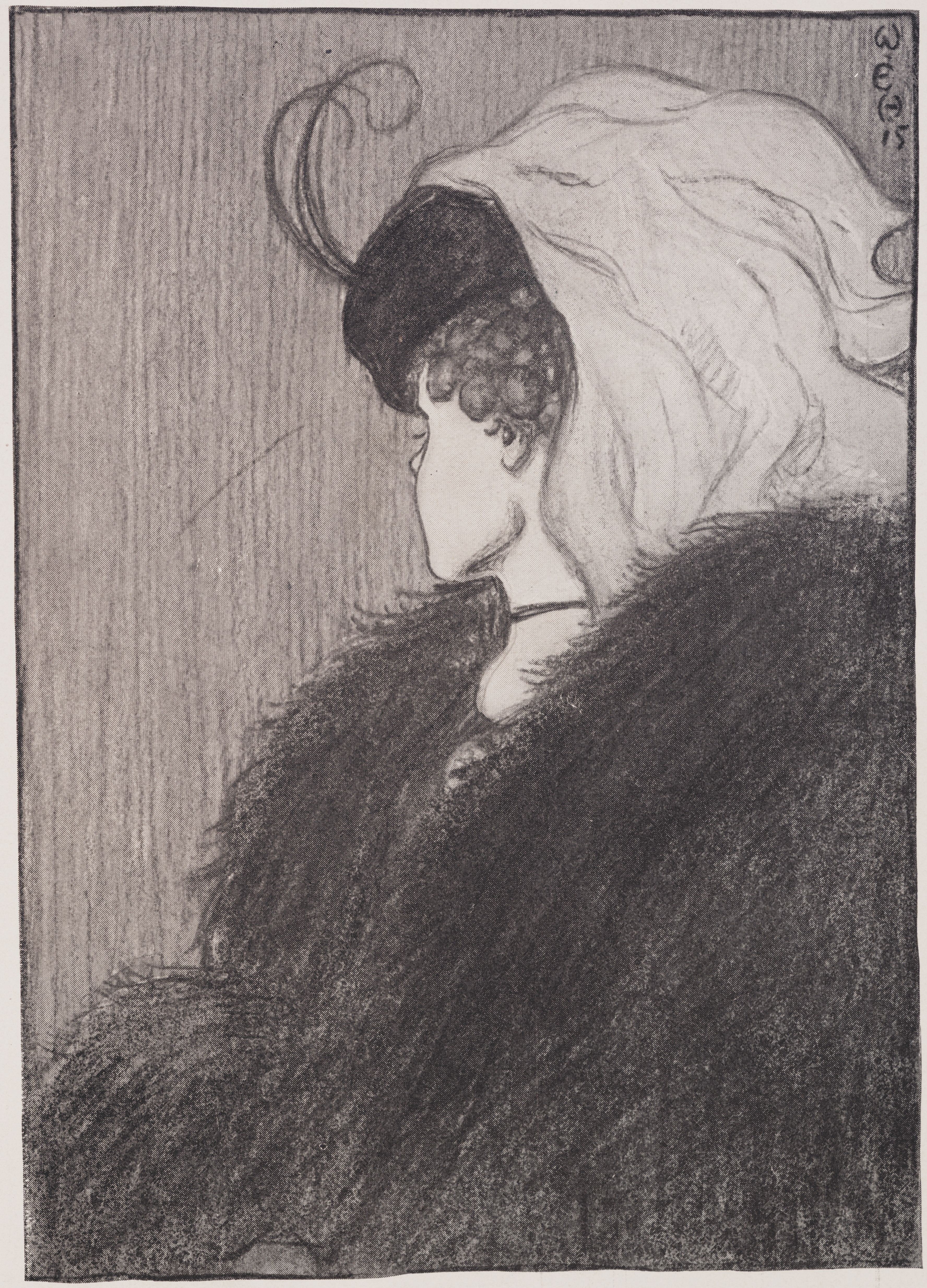
Source: Wikipedia (My Wife and My Mother-in-Law)
She saw me walking in.
Seeing a little too much innocence,
Thinking up a way to get me to pay
For some needed experience.
She saw me walking in.
The arrogant smile solidifying her intent.
A plan in place to put me in my place
Made her content.
She saw me walking in.
Sensing the weighted pockets from undeserving work.
Rationalizing an inheritance that deserves syphoning,
From the silver spoon to the plastic fork.
I wonder who she saw.
Her façade exposed, with
My wide eyed smile,
My cocky grin,
My condescending smirk.
Huh, I wonder what I saw?
Translation Not Possible
There is an episode of Star Trek’s The Next Generation (yes I am a sci-fi nerd) where we are introduced to an alien species that only communicates through metaphors and allegories. This method of communication is incomprehensible to others who only here the nonsensical strings of individual words even with the technology to translate languages universally.
Whenever I watch an old Somali Riwaayad, the ones where everyone is on stage with the blurry VHS quality (you know the ‘classics’ I am talking about), I always feel like Captain Picard from that star trek episode. I can understand a lot of the individual words, but I am keenly aware that I’ve missed something completely as my mom laughs during one exchange or when my dad nods in agreement at a soliloquy.
When I was younger, this didn’t really bother me too much. I knew I could carry on a conversation (with some somaglish in between stutters) But as I grew older, that gnawing realization of the missing link was becoming apparent. The language was riddled with context and history.
Not surprisingly, this was occurring as I was starting to become interested in the written word beyond having it forced on me in school. Finding writers and poets I can better relate to. I started to fully appreciate poetry, written stories, and essays in my adulthood. And as my reading increased, so did my vocabulary and ability to understand the writer better. Like listening to music on a standard headset or speaker. Thinking you here what the artist wanted you. Then switching to the better equipment and now able to hear the work completely – the subtle nuances, feeling of the bass, and appreciating the range of the vocals. My grasp of the English language has offered me new insights, but it has also highlighted the disparity in levels with my mother tongue. My grasp of the Somali language was limited to the level of a child/adolescent.
Being deprived of my language due to a limited grasp of the context and history meant that I’ll never be able to appreciate my people because I cannot understand its artists.
This is not a difficult leap. Beyond (and within) everyday communication, language transfers technical thoughts and abstract thoughts. When speaking of technical thoughts, think of the use of the language in engineering or sciences. In this realm language needs to be precise and can more easily be translated. Abstract thoughts are more difficult to translate. They lie in the arena of poets and story tellers. Since these thoughts can never truly be translated, it can arguably be said it is the essence of the language.
For example, take an important event in Somali history: Independence. The technical language can tell me the date and figures. However; the abstract language will be able to express so much more: the feelings and emotions.
I hope you can appreciate my feeble attempt to show something substantive (at least from my limited knowledge) and an idea that’s not so new. People are its language, language is its artist, and artist speak for the people.
And so, I am unable to understand the Somali artist because I cannot understand their language riddled with context and history. As such, I cannot understand my people.
Like the captain, able to appreciate but never able to truly comprehend.
Now left to and more able (I hope) to express myself in a language I was not born to.